How Does an Orthodox Christian Confront an Economic Crisis?
Download this article
Foreword
In 2009, I had the privilege of being a guest at the home of Ioannis and Katerina Kallianiotis. It is always a spiritually profitable experience when I am blessed to be in the home of pious, Orthodox Christian laity. The conversation was always edifying. Ioannis shared stories of his youth on a Greek island, far from the mainland. I recalled my time in Greece, where every Sunday after the Divine Liturgy the faithful gathered in parks or homes and where they had a tradition of ‶lay theologians″ who would speak on various topics. In Ioannis, I saw the sagacity of a lay theologian.
Upon understanding his accomplishment of being published in every Mount Athos journal, I pleaded with him to write something for American Orthodox Christians. At that time the world faced the challenges of the 2008 economic crisis, so I asked him to pen …
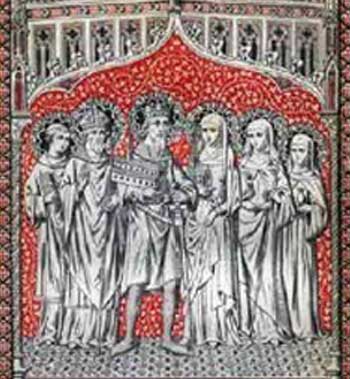
Saint Waldetrudis of Mons
Saint Waldetrudis of Mons (688)
Feast Day: April 9/22
Saint Waldetrudis (or Waltrude or Waudru) was born in the time of Dagobert I, who was king of the Franks from 629 to 638. Fidelity was her virtue as a bride and as a mother, then as a nun and as a hegumeness (abbess). She died on 9 April 688: she had then, between fifty and sixty years. Several decades later, her body was taken from the earth by Saint Hubert, bishop of Tongres, Maastricht and Liège. In 1250, on 12 August, her head was separated from the body in the presence of Nicholas, the bishop of Cambrai. In 1349, on 7 October, her relics were carried in procession in the streets of Mons, in order to obtain the cessation of the plague. Each year, the day after the feast of the Trinity, that is, on Second-day [Monday] after our …
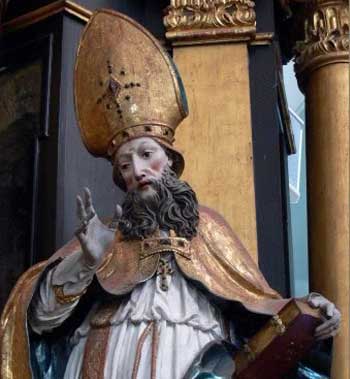
Saint Hilary of Arles
Saint Hilary of Arles (449)
Feast Day: March 30/April 12
Saint Hilary (or Hilarius) was born to a noble family in Lorraine, in northeastern Gaul (modern-day France). While still a youth, he sold his inherited estates to his brother, gave the profit away to the poor, and joined the abbey of Lerins on the island of Lerina, headed by his kinsman, St. Honoratus (an uninhabited island until Honoratus founded the monastery there, and since has been renamed to Saint-Honorat). After being elected bishop of Arles (in southern Gaul), Honoratus died, and Hilary was named his successor. He desired to stay isolated on the island, but accepted the episcopate as the will of God and went to serve the Church. He was esteemed for his great sanctity of life, and known for his ascetic deeds, strictness, almsgiving to the poor, and ransoming captives. Twice, he had difficult confrontations with Saint …
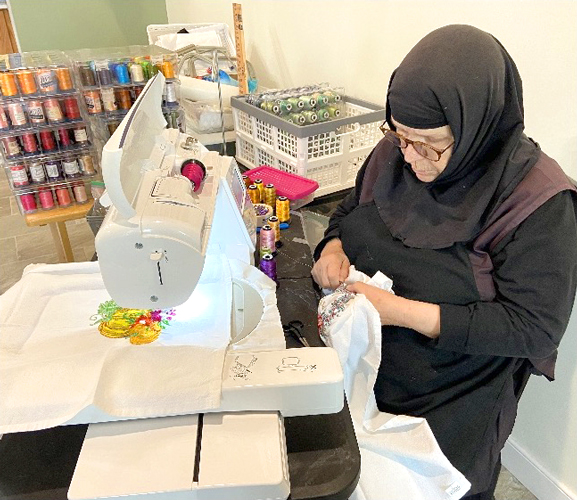
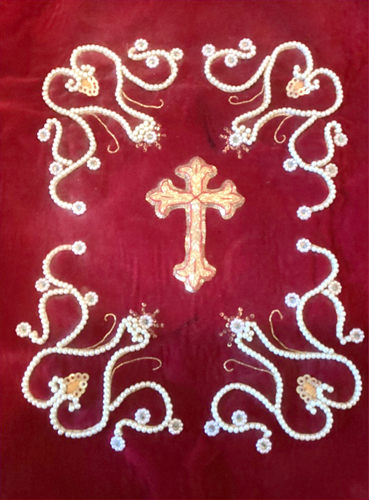
Sewing Room Update
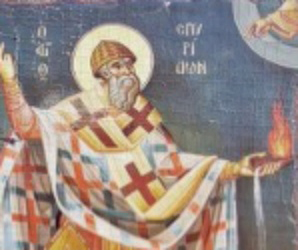
St. Spyridon’s Fish Meal
Saint Spyridon and the Miracle of the Fish
Translated into English for the Queen of All Skete by
Gerontissa Theonymphe, Παναγιοπουλα Μετοχι (Panagiopoula Μετochi), Corfu, Greece
Greetings from Corfu to all of you who follow the site of the blessed Queen of All Skete, evlogeite! I have translated for you, from Greek, an account of this miracle of our beloved Saint Spyridon. This story is recorded in the works of Saint Maximus the Greek, (Jan. 21/Feb. 3, 1556), who is known as the Spiritual Enlightener of Rus.
As most everyone knows, Corfu is blessed with the Holy Relics of Saint Spyridon the Wonderworker. These relics have been preserved for many ages in the center of town in an impressive Church called the ‘Ayio’, built in 1589. In order for the faithful to venerate the Saint’s holy relics, throughout the day clerics open the protective doors to the room which houses …
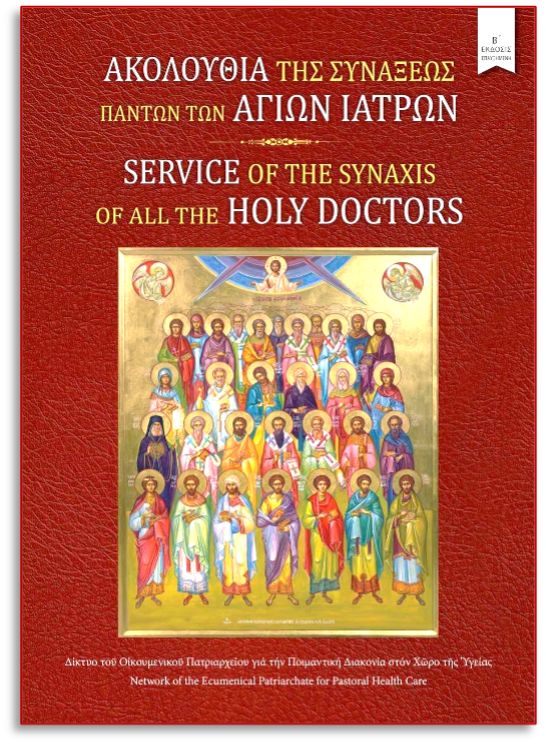
Service of the Synaxis of All the Holy Doctors
Service of the Synaxis of All the Holy Doctors
by Metropolitan Kyrillos of Rhodes,
translated By Bishop Spyridon of Amastris.
In 2021, the Greek Orthodox Church established the Sunday following the Sunday of the Holy Fathers of the 7th Ecumenical Synod as the Sunday of the Synaxis of all the Holy Doctors. This date was chosen because it falls close to the Feast of the Synaxis of the Holy Unmercenary Physicians (Oct. 17/30) and that of the Feast of St. Luke the Evangelist (Oct. 18/31), who was a doctor.
On this day, the Greek Church honors medical doctors and all those in the healthcare industry for their essential contribution and ministry to mankind. The Feast and this Liturgical Service conveys the Church’s concern regarding the spiritual care for every sick and suffering person, and sheds light on the need for dialogue between the medical community and the …